Autonomous Hiring vs Traditional Recruiting: A Side-by-Side Breakdown
Autonomous hiring and traditional recruiting are not two versions of the same process — they are two fundamentally different architectures for connecting talent with work. Traditional recruiting is reactive, application-driven, and optimized for volume. Autonomous hiring is continuous, signal-based, and optimized for fit. Understanding the structural differences between them is essential for any organization evaluating how to modernize its talent acquisition function.
Traditional recruiting starts from zero with every new role — autonomous hiring runs continuously in the background before a role is ever posted.
Traditional systems evaluate candidates through resumes and keyword filters; autonomous hiring uses multiple independent behavioral and contextual signals over time.
Autonomous hiring eliminates algorithmic rejection — AI surfaces matches, but humans make every decision about who to engage and who to hire.
The candidate experience in traditional recruiting is defined by applications, waiting, and ghosting; in autonomous hiring it is defined by limited, targeted, context-rich engagement.
The biggest difference is not speed — it is the quality of signal and the distribution of accountability between AI and humans.
The performance gap between the two approaches is documented and growing:
Companies using continuous talent intelligence pipelines reported a 40% reduction in time-to-hire for senior technical roles compared to application-based processes (LinkedIn Talent Solutions, 2025).
72% of hiring managers say they have rejected a strong candidate through automated screening because the resume did not match the keyword criteria — not because the candidate lacked the skills (Harvard Business School, 2024).
The average corporate job posting receives 250 applications; recruiters spend an estimated 6 seconds per resume during initial screening, meaning over 90% of applicants receive less than one minute of evaluation (Glassdoor Research, 2025).
Candidates who are discovered and approached directly — rather than applying to posted roles — have a 38% higher offer-acceptance rate than inbound applicants (Gem Recruiting Benchmark Report, 2025).
Only 30% of the workforce is actively looking for a new role at any given time; signal-based hiring reaches the other 70% — the passive talent that traditional job postings structurally cannot access (LinkedIn Global Talent Trends, 2026).
How the two systems start: reactive vs continuous
The most fundamental difference between traditional recruiting and autonomous hiring is not a feature or a technology — it is the moment the process begins.
Traditional recruiting begins when a role opens. A hiring manager submits a requisition. A recruiter writes a job description. The posting goes live. The process starts from zero every single time, with no accumulated context, no pre-existing candidate relationships, and no intelligence from previous cycles informing the new one. Every hiring effort is its own island.
Autonomous hiring has no starting gun. The system runs continuously — observing signals, building context, and mapping alignment between talent and opportunity whether or not there is an active job opening. When a hiring need emerges, the infrastructure already has relevant candidates in view. The recruiter is not starting a search; they are reviewing a recommendation that the system has been quietly developing for weeks or months.
This distinction matters more than it might initially appear. In a market where the best candidates are employed, not searching, and where top talent has offers within days of becoming available, the speed advantage of a continuous system is decisive. By the time a traditional recruiter has written a job description and waited for applications, the candidates they most want have already moved.
How candidates are evaluated: resumes vs signals
Traditional recruiting relies on the resume as its primary unit of evaluation. The resume is a static, self-reported document — written once, optimized for keyword detection, and often outdated. Applicant tracking systems filter resumes by matching keywords from job descriptions, which means a candidate who has the right skills but describes them differently may be excluded before any human ever reads their application.
This creates a perverse dynamic: the candidates who are best at writing resumes are not necessarily the candidates who are best at doing the job. And the candidates who are most overqualified — who find the job description too basic to bother tailoring their resume for — may never apply at all.
Signal-based hiring replaces the resume as the primary input. Instead of a single static document, it draws on multiple independent signals that accumulate over time:
Career trajectory signals show the direction and velocity of a candidate's growth — not just their current role, but the arc of their progression and the complexity they have navigated at each stage.
Work context signals capture the environment in which skills were applied — the stage of company, the scale of systems, the composition of the team. Two candidates with identical titles may have operated in fundamentally different contexts.
Engagement and preference signals reflect what a candidate actually responds to — what opportunities interest them, what they have engaged with in the past, what they have consistently declined. These signals build a preference model that makes matching more accurate over time.
Demonstrated capability signals go beyond self-reported proficiency to incorporate contributions, outputs, and validated achievements in relevant domains.
Critically, these signals update continuously. A resume reflects who a candidate was when they wrote it. A signal profile reflects who they are becoming.
How candidates enter the process: applications vs consent-indexed discovery
In traditional recruiting, candidates enter the process by applying. They find a job posting — through a job board, a company careers page, a LinkedIn recommendation, or a referral — and they submit an application. The entire candidate pool is self-selected and self-reported.
This creates two structural problems. First, it excludes the passive majority — the 70% of employed professionals who are not actively searching but might be open to the right opportunity. Second, it floods recruiters with volume, because job postings are a broadcast mechanism: they reach everyone, including people who are clearly unqualified, which means the signal-to-noise ratio degrades as the posting reaches more people.
Autonomous hiring inverts both problems. Candidates enter not by applying but by opting into a consent-driven talent index. They provide structured information about their skills, trajectory, preferences, and availability — knowingly, for the specific purpose of being discovered for relevant opportunities. No data is scraped without awareness. No shadow profiles are assembled.
This means the candidate pool in an autonomous system is smaller but dramatically higher quality. Every person in the pool chose to be there. Every signal they provided was intentional. And because the system is always matching rather than waiting for applications, the right candidates can be surfaced even when they are not actively looking.
How decisions are made: algorithmic filtering vs human-accountable matching
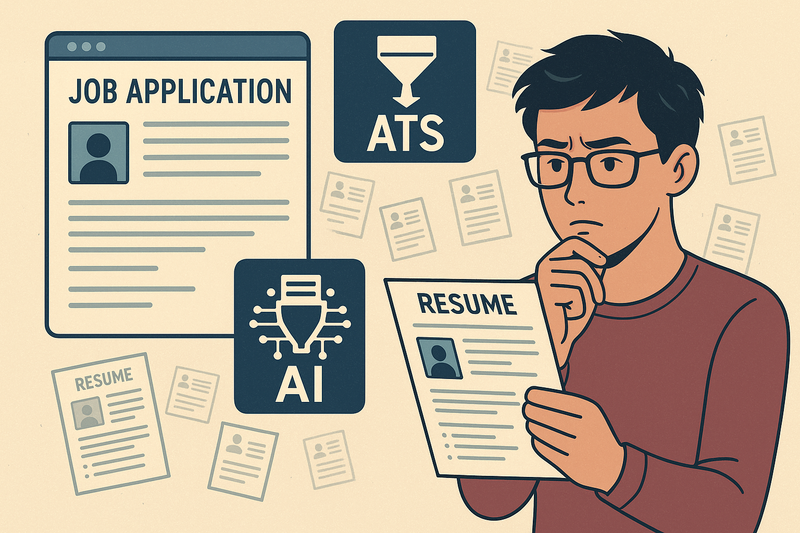
In traditional recruiting, the first wave of decisions is made by algorithms — ATS filters that accept or reject based on keyword criteria. These decisions are largely invisible: candidates receive a form rejection email, or no response at all, with no explanation of why they were excluded. Accountability is diffuse and decision-making is delegated to rules that no single person designed end-to-end.
In autonomous hiring, AI never makes rejection decisions. AI proposes — surfacing candidates whose signals align with an opportunity, explaining what contributed to the match and what was not used. Humans decide — reviewing the AI's recommendations with contextual judgment that no algorithm can replicate. Candidates choose — engaging or not engaging based on clear, upfront context about the opportunity.
This three-party accountability structure ensures that no career-affecting decision is made without a human owner. A candidate who is not surfaced for a particular opportunity has not been rejected — they simply were not the best match for that specific context. The system surfaces possibilities; it does not pronounce verdicts.
What candidates actually experience: volume processing vs dignity-first engagement
From a candidate's perspective, traditional recruiting is often an experience defined by waiting and silence. They submit an application. They wait. They receive an automated rejection — or nothing at all. If they make it past the initial screen, they may wait again between each stage. They may complete interviews, demonstrate their capabilities, and invest hours of preparation — and then be ghosted after the final round.
This experience is not incidental to the architecture; it is produced by it. When a recruiter is processing 300 applications for a single role, they cannot give each one a thoughtful response. The volume makes dignity impossible.
Autonomous hiring is architecturally designed to produce a different experience. Because the system surfaces a small number of high-fit candidates rather than filtering a large volume of applications, each candidate can receive meaningful engagement. Before any outreach, the candidate already knows why they were approached and what signals contributed to the match. There are no surprise applications, no blind submissions, no silent rejections. Every candidate who enters a process knows they were specifically chosen — and knows what factors drove that choice.
Scenario: Two startups hire a senior product manager. One uses traditional recruiting. One uses autonomous hiring.
Company A — Traditional: The head of talent writes a job description and posts it on LinkedIn, Naukri, and the company careers page. Over ten days, 287 applications arrive. The ATS filters 191 based on keyword matching — "product roadmap," "stakeholder management," "B2B SaaS." The recruiter spends two days reviewing the remaining 96 resumes, conducting 14 phone screens, and scheduling 6 first-round interviews. Of these, 2 candidates reach the final stage. One accepts an offer — 38 days after the process began. Three of the 191 automatically rejected candidates, it later emerges, had stronger product track records than the person hired. They never made it through the keyword filter.
Company B — Autonomous: The company has been running FyndX Atlas continuously. When the product leadership team confirms they need a senior PM, the system has already identified 9 candidates whose trajectory signals — progression from associate PM to lead PM at companies of comparable stage, demonstrated experience with B2B SaaS product cycles, and active engagement signals indicating openness to new opportunities — align with the context. The recruiter reviews the 9 matches, validates 4 as strong fits using contextual judgment, and initiates targeted outreach with clear context about the role and why each candidate was approached. Three respond positively. Two reach final interviews. One accepts — 21 days after the need was confirmed, with no job posting, no application flood, and no algorithmic rejection of anyone.
The same role. The same outcome. Seventeen fewer days. Zero silent rejections.
FAQ
Is autonomous hiring faster than traditional recruiting?
Yes, typically by 30–50% for senior roles — but speed is not the primary advantage. The more significant difference is signal quality. Autonomous hiring reaches candidates whose fit has been building in the system over time, which means the validation work is faster and the offer-acceptance rate is higher. Speed is a byproduct of better upstream intelligence, not just a faster process.
Can traditional recruiting and autonomous hiring coexist in the same organization?
Yes — and for most organizations, a hybrid approach makes sense during the transition. Traditional application-based processes can continue for entry-level or high-volume roles while autonomous hiring handles senior, specialized, or hard-to-fill positions where signal quality matters most. Over time, as the talent index grows and signal accumulation compounds, the autonomous layer typically expands.
Does autonomous hiring work for roles outside of tech?
The infrastructure is role-agnostic, but the signal density is currently highest in technology domains — software engineering, product, AI, data science — where behavioral and contextual signals are richer and more legible. Expansion to other domains depends on building signal infrastructure in those areas, which is part of the roadmap for more mature versions of the platform.
How does autonomous hiring handle candidates who want to apply directly?
Autonomous hiring does not replace the ability to express interest — it supplements the discovery model. Candidates who want to proactively signal availability can do so through the consent-driven talent index. The difference is that their profile is built on structured signals rather than a resume, and their engagement is targeted rather than broadcast.
What happens to the candidates who are not surfaced for a role?
They are not rejected — they simply were not the best match for that specific context. Autonomous hiring does not issue rejection notifications for candidates who were not surfaced, because being not-surfaced is not a verdict. It is a statement about fit for one specific opportunity. Those candidates remain in the talent index and may be surfaced for future opportunities whose signals align more closely with their profile.
Is traditional recruiting going away?
Not immediately — and perhaps not entirely. Job postings will continue to exist for roles where application volume is manageable and the candidate pool is active. But for senior, specialized, or passive-candidate roles — which represent the highest-value hiring decisions most organizations make — the architecture of traditional recruiting is becoming structurally inadequate. The shift to signal-based, continuous hiring is already underway. The question is not whether, but when and how fast.
About the Author
Pradeep Kumar is the CEO and Co-Founder of FyndX, building autonomous hiring intelligence for organizations that want to hire the right people faster, without applications, scoring, or scraping. Pradeep Kumar writes about the future of talent infrastructure, responsible AI in hiring, and what it means to build systems that treat candidates as participants, not inventory. Connect on https://www.linkedin.com/in/pradeep-fyndx/.
Last updated: May 2026